Luoyang Judian Metal Hot Processing Equipment Co., LTD is mainly engaged in the manufacture of complete sets of equipment in the metal thermal processing industry and the integration of the entire production line.
If you run a melt shop or a high‑temperature process line, you already know this hard truth: fouled furnaces quietly drain money. Deposits raise tube temperatures, slag and dust hide hot spots, and poorly cleaned linings accelerate wear. The result is longer tap‑to‑tap time, higher kWh per ton, unexpected downtime, and compliance headaches. This guide turns industrial furnace cleaning into an operational lever for ROI—grounded in safety standards, practical methods, and maintenance discipline.
1.Why cleaning matters for ROI, uptime and compliance
Clean furnaces convert energy into heat more efficiently, transfer that heat uniformly to the charge, and keep emissions within permit limits. Fouling—coke on fired heater tubes, slag build‑up around EAF doors, dross in reverberatory furnaces, dust in induction coil spaces—adds resistance and blocks flow. You pay for that resistance twice: in energy and in time.
Quantified outcomes are documented in credible industry sources. In fired heaters, robotic convection section cleaning has restored thermal efficiency by around 3%, boosted steam production roughly 20%, increased superheat by 10–15°C, and reduced fuel and CO2 up to 15%, as reported in a service case by TubeTech in 2022–2023 (refinery context) according to the TubeTech fired‑heater fouling removal case study. Enhanced IR monitoring and optimized decoking have increased rates and stabilized tube metal temperatures, per Inspectioneering’s 2021–2022 coverage inleveraging IR and decoking to increase throughput and heater tube temperature monitoring best practices.
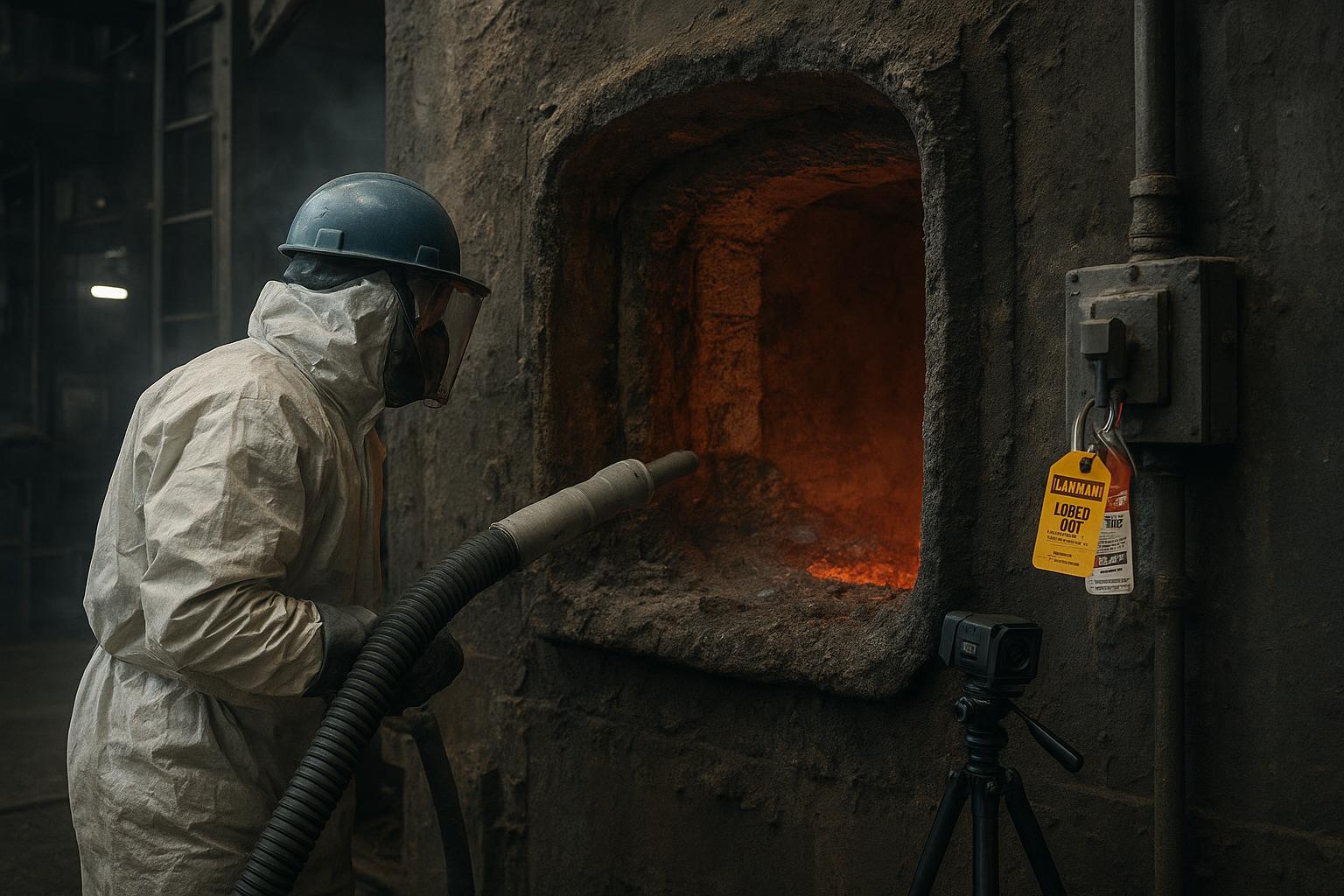
Cleaning also safeguards compliance. OSHA requires lockout/tagout (LOTO) for servicing where unexpected energization or stored energy release could injure workers; programs must include written procedures, training, and periodic inspections, as clarified in OSHA’s 2024 interpretation memo and enforcement guidance in Lockout/Tagout feasibility and temporary removal and Instance‑by‑Instance Citation Policy. Confined space entry rules apply when a furnace meets permit‑required conditions; see OSHA 1910.146 in the Permit‑Required Confined Spaces standard.
2.The KPI lens owners and engineers should track
Energy intensity (kWh/ton or fuel per melt)
Tap‑to‑tap time (or cycle time)
Uptime percentage and unplanned downtime hours
Yield and scrap rate
Refractory campaign life (heats or days)
Safety and permit adherence (e.g., LOTO audits, confined space permits, hot work compliance)
If you can’t see these metrics weekly, you can’t manage ROI. Cleaning should show up as improved energy intensity, faster cycles, fewer permit variances, and longer lining life.
3.Furnace types and tailored strategies
Every furnace fouls differently. The right industrial furnace cleaning plan depends on design, duty cycle, fuels, and charge composition.
Electric arc furnaces
EAFs accumulate slag at the door, spatter on the shell, and dust around off‑gas systems. Clean slag door operations reduce manual exposure; automation helps maintain closed‑door operation, which is safer and more efficient. AIST’s safety guidance emphasizes minimizing manual door cleaning and leveraging automated systems and wall injectors to stabilize foamy slag and process conditions; see AIST’s Safety First column and technical notes in slag door operations and safety and wall injector guidance.
Cleaning tasks typically include:
Mechanical removal of slag and spatter during scheduled cool‑downs
Vacuuming dust from the furnace deck, ducts, and baghouse inlets with HEPA filtration
Inspecting and brushing around electrode arms and cable paths
IR scans of shell to identify hot spots and guide patching
Induction furnaces
Induction operations suffer from slag accumulation, dross, and dust that can infiltrate coil spaces or attack linings. Fundamentals include strict power isolation and LOTO before maintenance, charging only dry material, robust PPE, and cooling system integrity checks. Inductotherm’s safety test highlights these controls; review their guidance in Foundry Safety Test.
Cleaning practices:
Skim slag/dross routinely with mechanical tools; use fluxes or binders appropriate to the alloy per refractory/OEM recommendations
Vacuum dust with non‑conductive tools; avoid compressed air that redistributes fines
Inspect lining for spalls and chemical attack; patch with gunning/fettling compounds as needed
Verify coil cooling passages and electrical connections are debris‑free before re‑energizing
Fired heaters and convection sections
In refining and petrochemical service, coke and particulate fouling raise tube metal temperatures (TMT) and cut throughput. Convection sections foul between tube rows, reducing heat recovery. Cleaning methods range from mechanical decoking and steam‑air decoking to robotic convection section cleaning. Inspectioneering documents IR‑guided operation and decoking benefits; see IR and decoking optimization to increase throughput.
Cleaning practices:
Periodic IR thermography to identify hot tubes and fouled patterns
Decoking cycles planned by TMT trends and pressure drop thresholds
Robotic cleaning for convection sections to remove deep fouling without dismantling
Rotary, reverberatory, vacuum and crucible furnaces
Rotary and reverberatory furnaces build slag/dross that impedes heat transfer. Cleaning focuses on scraping and skimming during planned cool‑downs, using alloy‑compatible fluxes, and inspecting refractory for chemical attack. Vacuum furnaces require OEM‑specific protocols: cool to ambient, HEPA vacuuming and soft brushing, solvent wipes with OEM‑approved cleaners (e.g., IPA), and avoiding compressed air or water jets that can damage graphite or molybdenum components. Always defer to the OEM manual; vacuum chambers can be sensitive to chemical residues and moisture.
4.Safety and permits you must lock in first
Before anyone opens a manway or points a lance at deposits, secure the basics.
Lockout/Tagout (LOTO): OSHA 1910.147 requires written, machine‑specific procedures, training, and periodic inspections. Temporary removal and re‑energization are strictly controlled; see OSHA’s 2024 interpretation in Lockout/Tagout feasibility and temporary removal. Enforcement emphasis is described in Instance‑by‑Instance Citation Policy.
Confined space entry: Many furnaces meet permit‑required confined space criteria. Implement a written program, atmospheric testing, ventilation/purging, attendants, rescue provisions, and permits per OSHA’s 1910.146.
Hot work controls: Cutting, welding, or lancing near combustibles demands permits, removal/protection within 35 ft, and a fire watch, per OSHA guidance in Fire Watch Duties fact sheet and the hot work topic page.
Respiratory protection: If blasting or brushing raises dust above PELs—or if CO2 accumulates during dry ice cleaning—you need a written program, fit tests, and NIOSH‑certified respirators per OSHA 1910.134 program guidance.
NFPA 86 purge and ignition safeguards: Ovens and furnaces must be purged before ignition; proof‑of‑purge interlocks and airflow verification are essential. For training and summaries, see IHEA’s seminar covering NFPA 86:2023 in Safety Standards & Codes Seminar.
5.Refractory inspection and repair playbook
Cleaning removes fouling; inspection protects the lining that keeps heat where it belongs. Think of refractory like your brake pads—ignore wear, and the shell pays the price.
Visual and IR checks: Scan for hot spots; abnormal heat signatures often point to gaps, cracks, or thinned zones. Inspectioneering offers heater IR monitoring best practices in tube temperature monitoring.
Dust and slag removal: Vacuum residues with HEPA filtration; avoid dry sweeping that re‑suspends fine particulates.
Endoscopy/boroscope and thickness measurement: Use borescopes for internal cracks; thickness checks or embedded sensor bricks (e.g., RHIMagnesita ANKER ROCS) provide objective wear data; see residual thickness measurement overview.
Patch vs. reline decisions: Indicators include remaining thickness (~30% of original in steel ladles can trigger demolition), crack propagation, persistent hot spots, and economics. RHIMagnesita case notes show targeted replacements can extend campaigns significantly; see steel ladle lining management.
Heat‑up/cool‑down discipline: Follow OEM schedules; thermal shock ruins patch work and shortens life.
6.Scheduling and integrating with CMMS and IIoT
How often should an industrial furnace be cleaned? It depends on duty cycle, fuel, alloy chemistry, refractory system, and permit constraints. Instead of fixed dates, use data‑driven triggers and plan windows around production.
Frequency framing: Daily light housekeeping (skim slag, vacuum accessible dust). Weekly checks for deposits in doors, ducts, and coil spaces. Monthly IR scans in high‑duty service. Shutdown cleaning when KPIs drift: energy intensity up >5%, pressure drop rising, TMT trending high, or tap‑to‑tap time slipping.
CMMS integration: Create machine‑specific cleaning procedures as work order templates, with prerequisites (LOTO, permits) and acceptance criteria (photos, IR plots, pressure drop logs). Maintain asset hierarchies and history for trend analysis; see SMRP practice notes in functional location basics.
IIoT triggers: Tie sensors to alerts—tube skin temperatures, shell IR, stack O2 variance (>2%), pressure drop increases (>5%), and vibration on fans/blowers. ReliabilityWeb outlines condition monitoring basics in IoT asset condition overview.
7.Waste handling and hazardous determination
Cleaning creates residues—sludges, spent chemicals, dust, dross—that may be hazardous waste. Generators must determine hazard characteristics (ignitability D001, corrosivity D002, reactivity, toxicity D004–D043 via TCLP) using EPA SW‑846 methods; see EPA hazardous waste characteristics.
Generator categories determine accumulation time limits and obligations:
Very Small Quantity Generator (VSQG): ≤100 kg/mo; ≤1,000 kg on‑site; generally no federal time limit while under the on‑site cap; see EPA categories overview.
Small Quantity Generator (SQG): >100 and <1,000 kg/mo; may accumulate up to 180 days (270 days if transporting >200 miles), per hazardous waste generator regulatory summary.
Large Quantity Generator (LQG): ≥1,000 kg/mo; may accumulate up to 90 days.
Satellite accumulation areas (SAAs) at or near the point of generation are limited to ≤55 gallons (or 1 quart acute). If the limit is exceeded, transfer to a central accumulation area within three consecutive calendar days, which starts the 90/180/270‑day clock, per EPA SAA compendium.
Evaluate applicability of organic air emissions standards (Subpart CC) and boiler/industrial furnace (BIF) rules if burning hazardous waste; see RCRA organic air emission requirements overview.
Troubleshooting common problems
Rising energy use, uneven heating, persistent hot spots—what’s the signal telling you?
Hot spots on shell or tubes: Check refractory wear and gaps; perform IR mapping and patch where thickness is low. Verify burners or electrodes aren’t directing heat unevenly.
Rising fuel use or kWh/ton: Investigate fouling in convection sections, slag/dross build‑up, blocked air paths, or poor purge/combustion controls. Consider robotic cleaning or a decoke cycle guided by IR.
Uneven heating and slower tap‑to‑tap: Look for deposits around doors, coil spaces, or charge obstructions; review slag practices and material dryness.
Slag carryover (EAF/ladle transfer): Adjust slag foaming and injection; clean spouts and doors; inspect ladle linings for attack.
How to choose a service partner
Cleaning vendors vary widely. To protect uptime and compliance, evaluate:
Standards literacy: Familiarity with OSHA LOTO/PRCS/respiratory, hot work, and NFPA 86 purge safeguards
Method breadth and fit: Demonstrated experience across mechanical, dry ice, decoking, robotic, and chemical methods
Documentation quality: Machine‑specific procedures, permits, before/after photos, IR plots, and acceptance criteria
Safety record and training: TRIR, near‑miss reporting, confined space and hot work training credentials
Response SLAs and global support: Ability to plan around your production windows and mobilize quickly