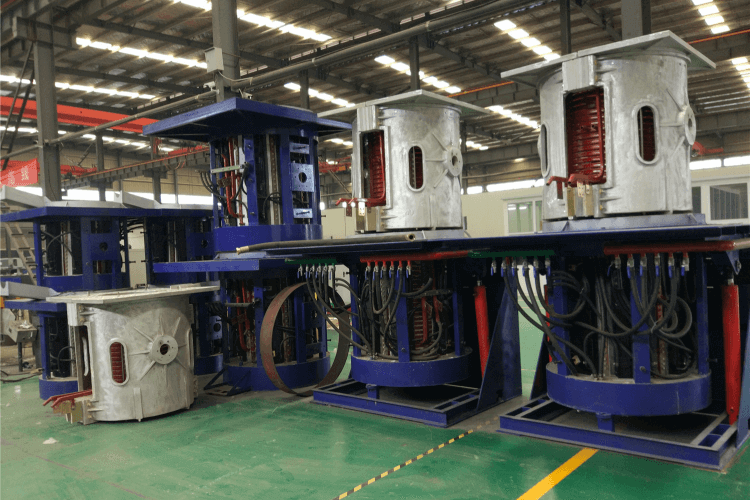
For factory owners and smelting plant general managers, investing in a large induction furnace is never a simple purchasing decision. At capacities of several tons per heat—or continuous large-scale melting—this equipment directly defines:
A large induction furnace is not an accessory to production. It is the core of production.
Yet many buyers still evaluate it as if they were comparing small machines—focusing on rated power, coil material, or headline price. In reality, the long-term performance gap between furnaces that look similar on paper can be enormous.

The difference comes from who designed it, how it was engineered, and what kind of manufacturer stands behind it.
Large-scale melting operations face a unique set of risks that smaller furnaces simply don’t amplify:
For decision-makers, the real concern is not “Can it melt metal?”
It is:
“Can this furnace run reliably, efficiently, and predictably for years—under real industrial pressure?”
This is why large induction furnace projects should always be evaluated from a total cost of ownership (TCO) and long-term ROI perspective, not initial procurement cost.
In large melting operations, time efficiency equals profit.
Experienced manufacturers design large induction furnaces to minimize:
Key design philosophies include:
The result is not just faster melting—but more heats per shift, more predictable scheduling, and less operator stress.
For factory owners, this translates directly into:
Energy is often the largest single operating expense in large induction furnace operations. A small percentage difference in efficiency becomes enormous at scale.
What separates experienced manufacturers from average suppliers is not peak power—it’s energy discipline over time.
A properly engineered large induction furnace delivers:
More importantly, it reduces:
For plant managers, this means:
Energy efficiency is not a marketing claim. It is a long-term financial strategy.
As furnace capacity increases, instability becomes exponentially more dangerous.
Technical directors and engineering managers care deeply about:
A large induction furnace designed by an experienced manufacturer prioritizes:
This ensures:
Safety is not just about avoiding accidents—it is about protecting production continuity.
Not all suppliers of large induction furnaces are true manufacturers.
Some outsource:
When problems occur, responsibility becomes fragmented.
A true large induction furnace manufacturer owns:
This matters because:
For large-capacity furnaces, manufacturing depth equals risk control.
Large induction furnaces are increasingly deployed in overseas projects—Middle East, Southeast Asia, Europe, and the Americas.
For overseas buyers, the biggest fears are:
Experienced export-oriented manufacturers build support systems that include:
A large induction furnace without reliable overseas support is not a cost-saving solution—it is a long-term operational risk.
Most furnaces perform well during the first months.
The real test begins after thousands of operating hours.
Strong after-sales systems include:
For factory owners, this means:
For engineering managers, it means:
After-sales service is not an extra—it is part of the furnace itself.
Large induction furnaces are ideal for:
They are not ideal for buyers who:
The most successful projects come from partnerships between manufacturers and clients who share a long-term mindset.
A large induction furnace is one of the most capital-intensive assets in a metal processing plant.
The right manufacturer delivers more than equipment:
When evaluated correctly, a large induction furnace becomes:
In large-scale melting, partnership matters more than price.


Induction billet furnaces can heat billets to temperatures ranging from room temperature to over 1200°C.

After the Slab is pulled out from the continuous casting machine,Surface temperature is 750 ~ 850℃.

The melting furnace mainly melting the steel, iron and metal. The equipment is mainly composed of power control cabinet and melting furnace body.